2026-09-20
So Many Surface Treatment Processes — What Problems Do They Actually Solve?
Writer: Views: 3
The 20th Guangzhou Surface Finishing Expo:
Exhibit: http://e.zbase.cn/11630bd5
Visit : http://e.zbase.cn/3d116bb6
Honestly, when it comes to surface treatments for hardware, many engineers who are just getting started tend to mix them up.
You often hear terms like: passivation, anodizing, micro-arc oxidation, chrome plating, blackening... there are all kinds of names, plus regional variations like "film formation" or "chemical conversion." They all sound similar, but in reality, each process differs completely in purpose, cost, effect, and application.
For example: why is nickel plating on magnesium alloys so difficult? Why does some aluminum get anodized, while other parts require conductive oxidation?
Behind these questions lies the same logic: what failure problem is surface treatment actually solving?
In essence, surface treatment is about solving different surface failure problems of a material. Broadly speaking, these processes fall into four categories:
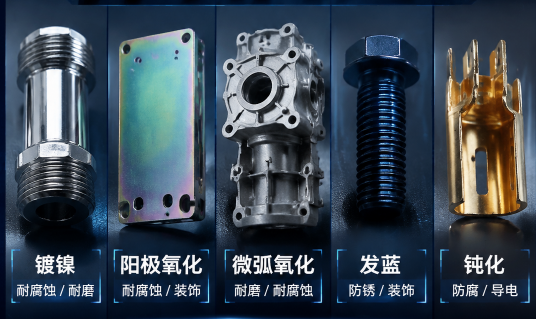
## 1. Plating (Coatings)
The idea is straightforward: add a new layer of material on the surface to give it new properties. Think of it as: if the base material isn't good enough, put something else on top.
- **Nickel plating**: often used for its corrosion and wear resistance, or as an intermediate layer for subsequent coatings.
- **Chrome plating**: may be for wear resistance, or simply for appearance.
But any added layer faces the same challenges:
- Is the adhesion between the coating and the substrate strong enough?
- Does the coating have pores?
- Is the internal stress too high?
- Can it cover edges, holes, and complex geometries?
So plating is never as simple as "just plate it on." If pretreatment, adhesion, and porosity control aren't done well, blistering, peeling, and corrosion failure will follow.
Why is nickel plating on magnesium so hard? Because magnesium is highly reactive — its surface readily forms oxides and hydroxides, which weaken coating adhesion. On top of that, the large potential difference between magnesium and nickel can cause even worse corrosion if the treatment is uneven. So the real challenge isn't the nickel plating itself, but the pretreatment and interface control.
## 2. Chemical Conversion Coatings
This is very common, but different from plating. Instead of adding a metal layer on top, it lets the surface itself react chemically to form a new film — essentially changing the material's surface state.
Examples: passivation, blackening (bluing), and passivation for magnesium, aluminum, and copper alloys. The so-called "conductive oxidation" for aluminum also belongs to this route.
The goal of passivation isn't a thick film. It's to stabilize the surface:
- Reduce oxidation
- Improve corrosion resistance
- Allow short-term storage
- Retain some conductivity while improving corrosion resistance
Many passivated parts are also sealed afterward to further improve stability and corrosion resistance. Salt spray testing is the typical quick evaluation method.
## 3. Electrochemically Grown Films
Anodizing and micro-arc oxidation are often confused with passivation, but they work differently. They use electrochemistry to grow an oxide layer from the metal surface itself.
- **Anodizing (aluminum)**: improves corrosion and wear resistance, and can add decorative colors.
- **Micro-arc oxidation**: goes further, producing a thicker, harder ceramic-like oxide film, commonly used on light metals like aluminum, magnesium, and titanium.
The trade-off: once the oxide film forms, surface properties change — including conductivity.
So why do some aluminum parts get anodized while others need conductive oxidation? It's not about which is "more advanced" — it's about different needs:
| Need | Process |
|---|---|
| Wear resistance, corrosion resistance, appearance | Anodizing |
| Conductivity, grounding, EMI shielding, contact in assembly | Conductive oxidation |
If you need conductivity, grounding, or shielding, film thickness alone is not the point.
## 4. Functional Coatings
Another category is special functional coatings:
- Spraying (thermal spray)
- Low-friction coatings
- Insulating coatings
- Coatings resistant to high temperature, chemicals, or wear
These coatings solve more than just corrosion problems. Sometimes it's insulation, sometimes low friction, sometimes simply surviving longer in harsh environments. So you can't just ask "how many hours of salt spray?" — the real challenges may be friction, media exposure, temperature, insulation, contamination, or a combination of them. The test methods must match the actual application.
## Why Are There So Many Surface Treatments?
Looking at all of this, the processes really just boil down to these few categories. But because materials differ, the problems differ — and no single process can solve everything.
So before choosing a surface treatment, you need to clarify:
- What is the material?
- Where is the risk of failure?
- What environment will it face?
- What performance is required in the end?
Corrosion resistance? Wear resistance? Conductivity? Insulation? Appearance? Or a combination of several?
Only then can you decide which process to use.
In the end, the essence of surface treatment is simple: it adds to the material's surface the capability it originally lacks.
Source: Surface Treatment Analysis 表面处理解析
Return
Previous: None